
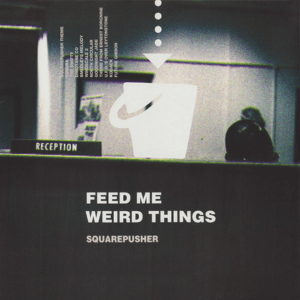
Feed Me Weird Things came out in 1996 on Rephlex Records, the label set up by Aphex Twin (aka Richard D James) with his business partner Grant Wilson Claridge. Tom Jenkinson (aka Squarepusher) had already been making something of a name for himself with releases on experimental drum’n’bass imprint Spymania and came to the attention of Aphex Twin after playing a gig at the George Robey Pub in Finsbury Park. An experience which is memorably recounted in the sleeve notes.
There’s no mistaking the fact that even at this early stage in his career, Squarepusher had a unique and distinctive sound, one that synthesised disparate influences: jazz, jungle, acid house, in its marrying of sampled and chopped breakbeats with live bass guitar and other instrumentation. But for all its original ideas and the freewheeling creativity, Feed me Weird Things is a somewhat flawed album, even if its worst crimes are youthful naivety and surfeit of ambition.
Over the course of 12 tracks spanning 60 minutes, Squarepusher demonstrates his prowess at arrangement and composition, with pieces ranging from almost straight-up drum’n’bass / jungle, to jazzier cuts featuring heavily chopped and processed breakbeats and his signature bass guitar, to more experimental forays that touch on dub, ambient or could come under the ‘drill and bass’ tag that got applied to lots of artists who were pushing the manipulation of breakbeats to new extremes, such as Luke Vibert and the aforementioned Aphex Twin.
Some debut albums arrive with an artist’s sound seemingly fully formed. Think Aphex Twin’s SAW 85-92, or Music Has the Right to Children by Boards of Canada, which have stood the test of time and now sit as seminal albums that practically defined a sound for a generation. Feed Me Weird Things is not one of those debuts; it’s too raw, too patchy and with more padding than it needs.
What it is, is the sound of a highly talented and creative artist experimenting and finding his voice. In just a few short years, Squarepusher’s technical and compositional prowess would far outstrip what he was doing on Feed me Weird Things, making it quickly sound dated. But the germination of some of his longest running creative concerns began here and listening back to it with the vantage point of familiarity with his subsequent work, you really get the sense that this is where those key ideas were given their first try-outs.
Let’s get into the detail of some of the specific tracks. The second cut, Tundra, is archetypal Squarepusher, and in Jenkinson’s own words was an attempt to combine hard-hitting tech step beats with an emotive melody. The deep and moody pads handily evoke the chilly title and differentiate it from ‘normal’ jungle. The rolling amen breaks when they come in are chopped and processed to precision, although not in a radically different way from what other d’n’b producers were doing at the time. We get treated to a brighter melody midway through the track, as if a little sunlight is breaking through over the arctic scene, before it’s back to the rolling beats and bassline. It’s an absolutely killer track, a moody jungle epic, that points the way for the genre to be elevated and is easily one of strongest pieces on the album.
In a similar vein, Theme from Ernest Borgnine is another undeniable banger, opening with a beatifically optimistic melody, which feels like a golden sun rising from the horizon, before a thumping 178bpm beat kicks in that would rouse the sleepiest raver. The sunny melody and breakbeats alone would make it a decent progressive-jungle track, but around the 6 minute mark, Squarepusher switches it up and introduces a savage 303 line that transforms the last few minutes into a frenzied acid rave-up. More rough and ready than Tundra but another banger.
Probably the best examples of where Squarepusher heads in a jazzier direction and accentuates the bass guitar are Windscale 2 and The Swifty. Windscale 2 begins with a bass riff – which according to the sleeve notes he came up with as a teenager; the begins start out tentatively but then build in intensity, joined by ominous chords in the background, including a cello effect apparently created by rubbing a 50p coin on the string of his electric bass.
The Swifty is Squarepusher’s attempt to fuse jazz and dub. If the track has a ‘live’ feel to it, that’s because it was made before he’d obtained a multi-track recorder, which meant live elements – bass guitar and presumably keyboard – had to be played in single take alongside the sequenced parts. The second half sees more melodic elements introduced and is much more enjoyable, but again it’s a style that he would perfect shortly after on albums like Hard Normal Daddy. Here it feels the result is not quite the sum of its parts.
Two harsher cuts that point towards the ‘drill’n’bass’ sound that Squarepusher and others on the same scene would come to be associated with are Dimotane Co and North Circular, which test the outer limits of what’s possible by messing with sampled drum breaks. Dimotane Co one can just about imagine being played in a club, though you’d want to skip past the 20 second burst of white noise that opens the track, it does at least have a relatively consistent rhythm interspersed with a fizzing 303 line.
Playing North Circular at a party would be an easy way to get yourself banned from the stereo; it’s a dense claustrophobic piece of endlessly sliced and diced breakbeats and atonal effects. The title – a reference to the ring road that runs around North London – is apparently a suggestion that this be played at full volume in a car stereo. Neither track is for the faint-hearted, but if you like the harder end of drum’n’bass, or breakcore etc then they’re both cool proto-examples of the style.
Elsewhere, there’s a larkiness to Feed me Weird Things that rarely finds its way into Squarepusher’s sound beyond about 1998. Smedley’s Melody is a jaunty little jazz excursion, led by the live bass guitar – reportedly an attempt to use two time signatures simultaneously – and the amen break comes across like a drum from a marching band. As a bit of knockabout fun it’s kind of amusing but is definitely not the kind of experiment that would get past quality control on later records.
In the end, the bounty of ideas and creativity almost end up being Feed me Weird Things’ downfall, meaning it lacks coherence and cohesiveness as an album. And is too long, especially with the two bonus tracks on the 2024 vinyl reissue, Theme from Goodbye Renaldo and Deep Fried Pizza. But I don’t mean by that to judge it harshly. While some debuts may drop out of the sky fully-formed, many more are simply compilations of the best work an artist has made up to that point and this is very much what Feed me Weird Things feels like.
In retrospect, the different themes Jenkinson is tying together, and the unexpected synergies he unearthed – for example in freeform jazz and the boundary pushing experiments of jungle – would seem obvious. But here they feel too disjointed to present anything close to a coherent musical vision.
Instead I see Feed me Weird Things as Squarepusher’s manifesto, his mission statement, laying out his creative approach and staking a claim on a unique bit of territory on the musical landscape, somewhere between jungle, drum’n’bass, jazz, dub and rave.
It’s messy, it’s flawed and given he was operating in a style at the tip of the cutting edge, it was inevitable that it would sound dated as technology rapidly moved on. But it’s also bold, loud, fun and boundlessly creative. How many debuts can you think that incorporate this many ideas.

 George's Music Blog