

The vehicle for the multi-talented singer, songwriter, musician and writer, Michelle Zauner, are back with their follow-up to 2021’s triumphant Jubilee. Unsurprisingly given the title, For Melancholy Brunettes is a more downbeat and reflective affair than its jubilant predecessor. But if anything, it’s an even more impressive accomplishment; an artful and complex record of interlocking layers and references that only reveals its rewards gradually. I’d be tempted to go out on a limb even at this early stage, and say it’ll likely be appearing on many album of the year lists come December.
In essence, For Melancholy Brunettes is an expression of the grief, despair – maybe let’s keep it simple and just call it sadness – that Zauner experienced after seeming to attain everything she’d ever dreamed of: achieving a grammy nominated indie-pop hit with Jubilee followed by a best-selling memoir, Crying in H Mart, which mapped the unsteady trajectory of her early music career against the backdrop of her mother’s death from cancer. Zauner’s previous band were called Little Big League, and with critics flocking to praise both her music and writing, it seemed Japanese Breakfast were poised to break out of the little league and into the big one. But getting everything you thought you wanted won’t necessarily make you happy – just ask Icarus – nor will it exorcise the demons that lurk inside.
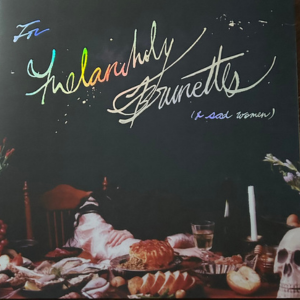
The album’s cover depicts Zauner slumped over a table piled high with luxurious food and drink, and much like in the renaissance paintings the image evokes, a skull – the reminder of death – watches over the uneaten feast. These literary and classical nods are just the start and for anyone so inclined, there’s a rabbit hole’s worth of references to go down, from the story of Leda, a Spartan queen who was seduced by a swan, to Thomas Mann’s visionary reflection on time, illness and death, The Magic Mountain.
Lead single “Orlando in Love”, with soaring strings and gently lulling cello, takes its name from the epic Italian renaissance poem, Orlando Innamorato – although in this updated retelling, the titular poet parks his Winnebago by the sea but drowns before finishing his last canto. The video, featuring Zauner playing the male protagonist, is also a nod to the gender fluid hero of Virginia Woolf’s Orlando: A Biography. Like the rest of the album, the arrangement is relatively stripped back with Zauner’s voice in the foreground, which allows the song to be propelled by poise and elegance – in contrast to the explosively celebratory arrangements on Jubilee.
There’s no getting away from the fact that Melancholy Brunettes is a deeply sad record, but like the best ‘sad’ music, Zauner crafts love loveliness from melancholy and the result is life-affirming and reassuring. The swelling harps on “Here is Someone” which opens the album create the fantastical sense that you’re entering a dream world, and offer something sweet in contrast to the bitterness of the line, “Life is sad, But here is someone”. This sweetness almost becomes a bit too syrupy at times. The production – handled by Blake Mills, whose credits include Bob Dylan, Laura Marling and Fiona Apple among many others – reminds me in a way of how Blur’s sound was treated on The Ballad of Darren (another deeply sad album), where it seemed all the hard edges had been smoothed away to give a softly muted polish. Fortunately “Honey Water” brings some guitar heaviness and a more muscular sound, piano-tinged art-rock that descends into a gorgeously strung-out shoegazey dirge.
The tempo – if not the underlying vibe – picks up with Mega Circuit, which feels like something of a sequel to Savage Good Boy from Jubilee. That was sung from the perspective of an Elon Musk-type figure serenading his wife in the nuclear bunker after the rest of the world has perished in the apocalypse. A scenario that feels even more horrifyingly likely now; Zauner inhabits the hearts of “young boys, so pissed off and jaded”, imagining herself the lover of someone “plotting blood with their incel eunuchs” and barrelling round the Maga Circuit.
The latter half of the album deals more heavily in its other key theme – the failure of male figures to live up to the demands of whatever role it is they’re supposed to embody: father, partner, leader. Following the death of her mother in 2014, Zauner became estranged from her father, who moved to Thailand and began a romantic relationship with a much younger woman. Obviously a complicating factor in her grief, to then also have to grieve the loss of someone still living. Sometime before the recording of this album they were reconciled to an extent, speaking for the first time in three years on a phone call which Zauner’s father answered with the words, “Tell me everything”. The following conversation is poetically recounted on “Leda” – a sparse acoustic ballad that meanders through the streets of Crete and over the gulf of time and space that separates father and daughter, ending on the conclusion, “I can’t relate to you at all”, suggesting that more than time and space lies between them.
Perhaps playing the role of the flawed father figure, Jeff Bridges makes an appearance on the piano-led bar ballad, Men in Bars, the closest the album veers to mawkishness or even self-parody. But something about the sheer far-fetchedness of finding Jeff Bridges pop-up on a Japanese Breakfast album just about carries it off.
For all the weighty themes of grief, loss and self-identity, and the density of references contained within, this is a slender record with ten tracks across half an hour. And while the production is lush, even luxurious at times, with harps, strings, pedal guitar and Zauner’s own girlish voice woven through everything, the strength of the song-writing wears the baroqueness lightly. Melancholy never descends into despair, and self-doubt never becomes self-pity. Some might prefer a sound with more grit and less polish, but taking her inspiration from Romantic literature, Zauner is asking us to suspend disbelief, even if just for half an hour. For Melancholy Brunettes (and sad women) is complex – but not complicated – an assured and impressive achievement from a deeply thoughtful artist.

 George's Music Blog