
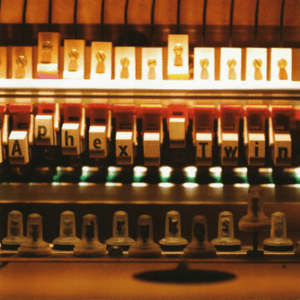
A true labyrinth of an album, Drukqs is a journey that might take you into the depths of your own psyche. And despite being (almost) completely instrumental expresses themes of grief, love, fear, yearning and all the rich tapestry of what it is to be human.
This is where it all started for me, ironically as Drukqs stands as something of an endpoint to Aphex’s unparalleled run of releases through the 90s, and was his contract-breaker with Warp Records before retreating from the limelight, not releasing another full-length for over a decade. Drukqs was supposedly released in a rush in order to pre-empt any internet leaks after James left a USB stick containing hundreds of tracks on a plane. Whether this is fact or folklore, I don’t know. Was it a way for James to retrospectively downplay the significance of the music by implying he had hundreds more similar tracks? Who knows, or cares really…? Drukqs met with mixed critical reception when it came out but has surely come to be treasured by a hugely diverse mix of fans and recognised as a pinnacle of electronic music.
I came to Drukqs probably in early 2002; Aphex Twin had been a figure at the periphery of my musical awareness but rose to interest when he was name-checked, along with others on the Warp roster, as significant influences on Radiohead in the making of Kid A (then my favourite band). My experience of electronic music to that point was confined to acts like The Prodigy, Moby, Chemical Brothers, etc though I was beginning to explore the wider ecosystem and sticking my toe in the waters of genres like drum’n’bass and techno.
But on putting disc 1 of Drukqs into my ghetto blaster (as we called them back then) and moments after the closing notes of Jynweythek died away, the spluttering breakbeats of Vordhosbn erupted out of the speaker and nothing was the same again. A musical epiphany like no other I can recall, it was as if the top of my head had been lifted off. This music was like nothing else I’d ever heard and it rearranged my idea of what was possible. Drukqs didn’t leave my stereo until I had to return the CDs to the library a few weeks later, but not before copying as much of it as would fit onto a cassette tape. I usually had a stack of rewritable CDs for that purpose but had run out at the time, so tape it had to be. That taped copy of Drukqs then bounced from my Walkman to the car stereo and back for the rest of that year – during which I finished my exams and left school – until at some point I obtained a CD copy.
Drukqs contains a mixture of beat-driven tracks in the 180bpm-ish range of jungle, showcasing James’ masterful programming skills, and a selection of sparse instrumental and ambient pieces; some featuring simple piano or other modified organs, and other more experimental works that would sound at home on Selected Ambient Works Volume 2. While I love all elements of the album, it was the frenetic breakbeat tracks that first dazzled me. Not just with their rhythmic complexity, but also the deeply heartfelt and meaningful melodic progressions and insanely detailed composition. Tracks like Omgyjya-Switch7 and Ziggomatic 17 were like the audio equivalents of an optical illusion that I just couldn’t stop looking at and enjoying the thrill of having my perception repeatedly confounded. The music seemed to me to be a puzzle – something that shouldn’t be possible but is – and I imagined the key to this mystery was encoded in the ‘other half’ of the album; that somehow one didn’t make sense without the other.
A criticism levelled against Drukqs at the time which I’ve always found baffling was that it retread old ground. Maybe that could fairly apply to some sections, but the drill’n’bass tracks which make up the heart of the album still sound like nothing else before or since to me. Maybe that’s because it was the first example of ‘this kind of music’ I ever heard – and we all know the first cut is the deepest – but I still feel as though I’ve never encountered anything quite on the same level. Listening to Drukqs was like experiencing technicolour for the first time and realising everything to that point had been black and white. Sure, the beat programming and compositional skills of a musician like Squarepusher are equally impressive, but his tracks have a different emotional character and just don’t take me to the same place mentally. In a similar vein, Venetian Snares frequently matches breakbeats with classical melodies, but not in a way that touches the same part of my soul. There’s something about Drukqs that creates its own mental plane: futuristic, alien, otherworldly, but also earthy, mystical, even spiritual – a place that seems to exist the core of my being.
There’s a decent case to be made for conceptualising it as the successor to SAW2, and not just because it’s also a double album; Drukqs inhabits the same uncanny dreamlike place that exists in one’s subconsciousness. Taking two of the most challenging pieces as examples, Gwely Mernans and Gwarek2, which could both fit comfortably on SAW2, each harbouring an ominous atmosphere that makes it easy to imagine you’re trapped somewhere dark and claustrophobic. Gwarek2 is a particularly difficult listening experience, featuring the recording of someone screaming – unadorned with any effects – so it’s literally as if you’re hearing the sounds of pain. Gwely Mernans is harshly beautiful in the right context, desperately bleak and lonely, with the barest shred of melodic colour coming from a piano that sounds like it’s been dropped to the bottom of a well. Not an appealing listen for many people, unless you’re in the mood for confronting the void.
There are plenty more curiosities to be found that fall outside the usual description of Drukqs as ‘drill’n’bass tracks interspersed with minimalist piano pieces’. Orban Eq Trx 4 is in Boards of Canada territory with its scratchy hip-hop beat and understatedly oppressive atmosphere. Bbydhyonchord is another mid-tempo number that reaches for a lighter mood, the handclaps and tribal drums calling to mind campfires and nights on the beach, but is so strongly nostalgic the mood almost collapses under the weight of its own bittersweetness. Most curious of all though, is the answerphone message from James’ parents Lorna and Derek wishing him a happy 28th birthday. Whether it’s due to the poor quality of the source material or an effect applied to the recording, Lorna’s voice is warped and crackly, giving it a ghostly feel. On a record largely devoid of spoken words it’s an arresting moment but in keeping with Aphex’s idiosyncratic way of humanising his work. The inclusion of this track always made me feel as though I was receiving the music live from his studio, punctuated with this minor domestic interruption of his parents ringing up (which probably happened frequently while he was making music).
But let’s turn now to the real heart of Drukqs. I’ve never got on board with the ‘drill’n’bass’ tag, which seems an unnecessary genre label and doesn’t do justice to how melodic and emotive the pieces on Drukqs are. Although going hard beat-wise, every composition is multi-layered and has a rich emotional dimension and narrative journey. The first we encounter on disc 1, Vordhosbn is immediately arresting with its skeletal (but intricately complex) beat and plaintive refrain which rises stratospherically to a goosebump-inducing climax just over a minute in. This section will always be associated in my mind with a particular stretch of road the school bus reached by the time the album got to this point on my daily listen. Many Aphex Twin tracks are reportedly written as love songs and it’s hard not to hear the surging breakdown as the expression of some deeply held emotion. I’m sure many will take their own meaning from it.
Omgyjya-Switch7 begins in a much more fragmented fashion, with the beat gradually assembling itself from ricocheting whip cracks and pops of distortion. These menacingly inhuman remnants are joined by another searingly emotive synth line, which after its climactic highpoint gives way to one of the most brutal passages of the entire album, where the kick drum is crushed into piercing shards of white noise.Cock/ver10 is a more straight-up acid breakbeat banger, though to be honest if I never heard another acid breakbeat banger in my life then this track would be enough. The obnoxious beat bursts out of the traps like a rabid dog intent on terrorising the dancefloor, becoming progressively more distorted before dropping out entirely to make way for the immortal exhortation “Come on you cunt, let’s have some Aphex acid!!”. Said acid is then distributed vigorously throughout the mix as the track builds to its frenzied climax.
The term ‘epic’ gets thrown around so much, it can lose meaning. But if the pair of 8 minute tracks, Mt Saint Michel + Saint Michaels Mount and Ziggomatic 17, which each sit at 13th place on their respective discs aren’t worthy of the description, I don’t know what is. In my mind electronic music so often takes the form of a narrative arc, which in the absence of lyrical content usually is composed of emotions or fundamental concepts: good and evil, love, fear, hope, conflict, resolution, redemption. In this context, Ziggomatic 17 unfolds as a story peopled with many characters; the ghostly melody hovering in the background of the opening sequence and which doesn’t come to the foreground until the outro many minutes later; the skittering bassline; the beat which seems to surge one way then another, the snares and hi-hats constantly threatening to erupt into overdriven chaos; the robotic screeching that appears ready to overwhelm the entire mix before being stilled suddenly by a jaunty tinkling of keys. I could go on and on.
Strangely enough, the track with far and away the most streams is one of the simplest, Avril 14th, a two minute piano piece which has been used countless times in TV and film and has somehow ended up being one of Aphex Twin’s most popular works. Its accessibility probably lies in its lighter tone, carried by a brisker pace than most of the more melancholy pieces on Drukqs, but it’s definitely not my favourite such piece off the album. As you’d expect with an album of 30 tracks, there are gems littered throughout. Kesson Dalek which closes out disc 1 is a minute and a half of beautiful, rippling piano notes that conveys an aching sense of loss and longing as the notes gradually falter and die away. In a similar vein, Hy A Scullyas Lyf A Dhagrow uses a similar prepared piano set up to the haunting and ethereal Jynweythek, and whose Cornish translation of ‘she shed a flood of tears’ tells you enough about the mood of the piece.
And it’s this emotional richness that elevates Aphex Twin’s music above so much else for me. Even the most fleeting interludes have an emotional quality so vivid and human, they can be almost painful to listen to. It’s perhaps for this reason that Drukqs is not an album I play often, despite the fact it barely left my ears for a period of some years. (Although having listened to it several times writing this piece, I now feel like it’s the only music I want to hear). Given the extreme distance between the highs and lows, it’s not a record that lends itself to casual or background listening. If you’re putting on Drukqs then you’re gonna be listening to Drukqs. And as with any album that embeds itself on your mind at an emotionally significant time – in my case those fraught mid-teenage years – listening to it will always take me back there, to some degree.
Yet even with the passage of time and all the music I’ve heard since, Drukqs remains my one of favourite albums by any artist, and possibly the album I’d choose if I could only listen to one record for the rest of my life. And somehow, buried in all its secret doors and hidden boxes, there’ll always be a piece of me
Thank you for your attention, bye.

 George's Music Blog